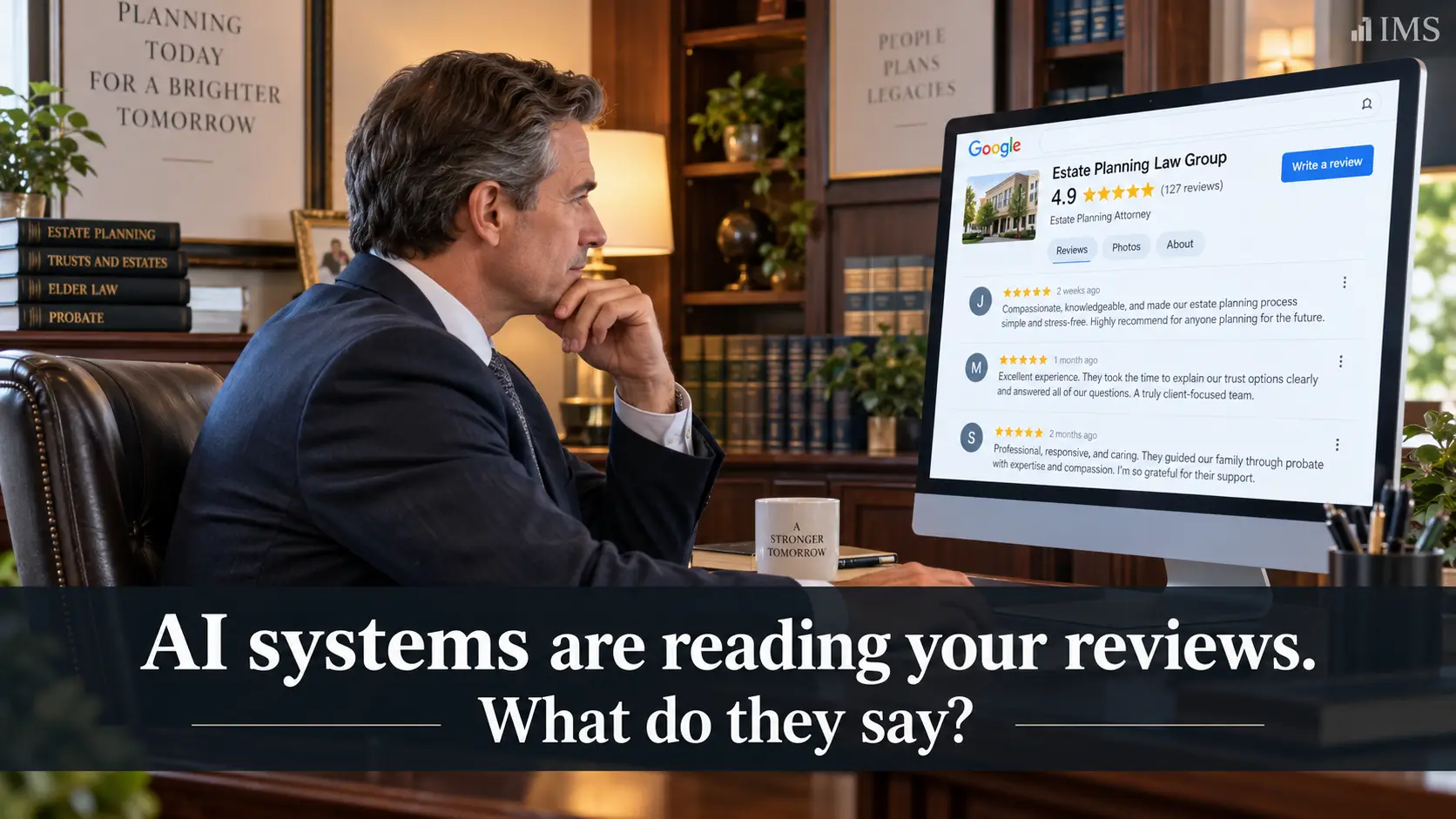
When attorneys ask me, “What can I do right now that doesn’t take a lot of budget, but could make a meaningful difference quickly?”
At IMS, we have lots of strategies that work to grow a law firm. But if you’re asking what you can do right now, without adding to the budget, and still make a noticeable difference, I have one answer
Reviews.
Specifically, your Google reviews.
Most firms still manage reviews as a reputation issue. They now also function as a visibility issue, because prospective clients are not the only ones reading what people say about your firm.
AI systems are reading, too.
Muck Rack’s research has found that earned media accounts for the overwhelming majority of AI citations: 82 percent in its December 2025 analysis of more than one million links, and 84 percent in its May 2026 update analyzing more than 25 million links.
That matters because AI systems often rely on what other people say about a business, not just what the business says about itself. A press mention is hard to influence by Friday. Reviews are different. They are third-party validation you can ask for this week from clients who already had a good experience with your firm.
The Rating Helps. The Review Text Does More Work.
A firm with 60 reviews and a 4.9 average has done well by the old scoreboard, and that number still matters to someone comparing three firms in three browser tabs. But if the last ten reviews all say a version of “great people, highly recommend,” the firm has produced very little context for either a prospective client or a search system.
Picture how the question actually gets asked now. Someone tells an AI assistant that their mother died in another state, the trust was never funded, and their brother is going to be difficult about it. The system is looking for evidence that a particular firm has handled that kind of situation. Fifty reviews praising your professionalism help establish trust. One review describing that specific issue gives both a reader and a search system more relevant context.
The rating says you are good. The words say what you are good at. Most firms have focused on the first and paid less attention to the second, even as review text has become more important to how people compare firms online.

A real-world example, received today: This review does more than give IMS five stars. It tells prospective clients—and search and AI systems—who we serve, what we do, and what the client values about the experience. Notice the language Richard used naturally: estate planning attorney, website firm, marketing vendor, website content, AI friendly. We didn’t give him those words. That’s simply how he described his experience—and that’s exactly why detailed, authentic reviews can be so valuable.
The 15-Minute Audit
Search your firm on your phone while logged out, or in a private browser window, and answer four questions.
How many reviews do you have, and how many do the firms Google shows alongside yours have? How many of yours arrived in the last twelve months? A profile with 85 reviews but only three from the past year can make an otherwise strong firm look less active than it is. Read the last ten and count how many name a real service or situation. Then open your practice management system and find the ten people most likely to say yes today: recently completed matters, clients who thanked your team in writing, clients who sent you a referral, and clients who have hired you more than once.
Change What You Ask For
Generic requests produce generic reviews. “We’d appreciate it if you left us a review” gives a well-meaning client nothing to work with, so you get four words of praise.
Ask instead what they found most helpful about working with your firm, and resist the urge to script the answer. A better question gives the client something concrete to answer: what they were worried about beforehand, how long the matter took, the complication nobody expected, or the relief of having it finished. That language is more useful to a prospective client and more descriptive for search systems.
What to Do Today
Send three requests today, in your own words, to three people from the list you just made. Then put the request into your closing checklist and give one person responsibility for it. A steady pattern of four or five reviews a month usually creates a healthier profile than a burst of thirty reviews every other year.
Reviews are one of nine forces reshaping how clients find, choose, and hire estate planning attorneys, and one of the lowest-cost places to start. The rest are documented in The Estate Planning Reset, our industry report on what has actually changed.
Download it free: https://imsrocks.com/estate-planning-reset/